S3P T&BD



Dr Roxana Maria Triboi
External Expert, Urban Agenda for the EU Food Partnership
Europe has invested in agrifood innovation, digitalisation and interregional cooperation. Yet our Action 3 analysis suggests that the central challenge is fragmented governance, not a lack of projects. Local food policies, regional Smart Specialisation Strategies (S3) and interregional partnerships often use separate teams, funding routes and accountability systems. A successful pilot may therefore end without changing regional priorities or later investment decisions. For a partnership that already mobilises strong technical expertise, the question is not simply how to generate more projects, but how to make them part of a coherent territorial transformation process.
The UAEU Food Partnership brings together governments, European institutions and networks. Action 3 of its Food Action Plan - Building Bridges between Local Authorities and Relevant Regional Strategies - examines the missing city-region link. Its lesson is constructive: rather than creating a parallel urban-S3 structure, municipal needs and evidence need a stable route into existing governance, investment and learning.
For the Traceability & Big Data partnership, cities are not an additional audience or simply testbeds. They organise public demand through procurement, kitchens, markets, logistics, land, waste and social services. This allows the partnership to examine whether data and digital solutions address connected food-system outcomes: competitiveness and adoption, but also affordability, health, inclusion, emissions, biodiversity and resilience. Shared challenge definitions, data standards, procurement learning and infrastructure can mutualise resources across initiatives and turn isolated demonstrations into a portfolio. Data then becomes infrastructure for governance and accountability, not only a technical asset.
Finland makes this institutional pathway visible. Regional councils are joint municipal authorities responsible for regional development and Smart Specialisation. In Seinäjoki, the 2021-2027 ecosystem agreement makes sustainable renewal of the food ecosystem a priority. Into Seinäjoki coordinates business and research actors, while regional and university partners connect this work to S3 networks, living labs and European programmes.
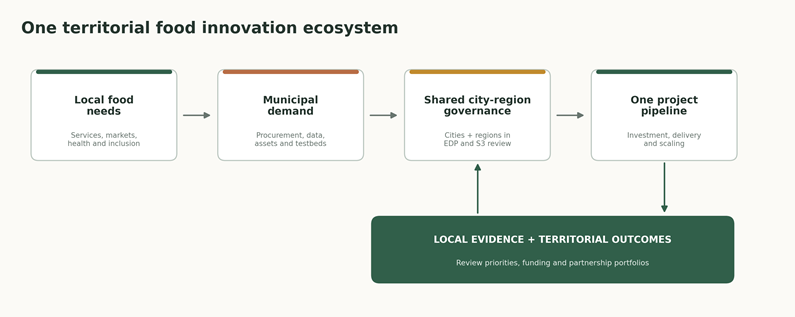
Figure 1. One territorial food innovation ecosystem and feedback loop. Credit: Roxana Triboi, 2026.
The critical Finnish lesson is not an administrative model to copy, but a set of governance functions: a shared priority, a recognised city role, a permanent intermediary, financed coordination and a route for local evidence to influence later decisions. Vantaa offers a complementary, project-led bridge between municipal assets, Helsinki-Uusimaa's regenerative food priority and CIRCULANDIA, but formal municipal influence remains less visible. This matters: participation in a project or event is not the same as power to shape priorities, selection criteria or funding.
The timing is important. Current criteria for new S3 partnerships emphasise regional mandates, S3 alignment, interregional complementarity, demonstration, commercialisation and scale-up, without an explicit city entry route. As discussions move towards 2028-2034, the evolving generation of partnerships can correct this gap. Cities should contribute to problem definition, entrepreneurial discovery, partnership governance, project pipelines and assessment - not join only during demonstration or dissemination.
For Traceability & Big Data, this means requiring each portfolio to identify the territorial challenge, municipal demand, S3 link, intermediary, adoption pathway, shared outcome indicators and formal feedback point. Brokerage, coordination and participation by smaller or less innovation-intensive territories need funding alongside technology. Otherwise, the best-connected regions will dominate and pilots may multiply without producing system change.
SOSFood, REDESIGN, RURACTIVE, eRural Resilience and Agrifood4Future already provide complementary entry points. Their wider value is as a coordinated portfolio: combining technical excellence with public action, sharing resources and evidence, and addressing social and environmental dimensions that no single project can cover.
On 2 September 2026, we invite cities, regions and S3 partnerships to review our emerging Action 3 results under the Food Action Plan, discuss what the Finnish experience reveals and provide feedback on the final recommendations. The objective is one territorial ecosystem in which city evidence strengthens regional and interregional impact.
Wednesday, 2 September 2026 | 10:00–11:30 CEST
Connecting local food strategies with S3/RIS3 and regional programmes — Action 3
The webinar will explore how local food strategies and urban agendas can be better connected with Smart Specialisation Strategies and other regional programmes, and how cities can play a stronger role in shaping territorial food-system innovation and funding.
Event information, policy brief and registration: https://www.urbanagenda.urban-initiative.eu/events/webinar-connecting-local-food-strategies-s3ris3-and-regional-programmes
Wednesday, 9 September 2026 | 10:00–11:30 CEST
What enables local food policies? National and regional support frameworks — Action 2
The webinar will examine how national and regional frameworks can provide cities with stronger mandates, coordination, capacity, networks and more stable support for local food policies.
Event information, policy brief and registration: https://www.urbanagenda.urban-initiative.eu/events/webinar-what-enables-local-food-policies-national-and-regional-support-frameworks
Dr Roxana Maria Triboi is an architect and urban planner specialising in sustainable and resilient food systems, city-region governance and local food policy. She supports Actions 2 and 3 of the Urban Agenda for the EU Food Partnership as an external expert.
● Urban Agenda for the EU Food Partnership - official partnership page and Action Plan
● Traceability & Big Data - Communication - newsletter and articles
● Shaping the Future of Traceability & Big Data - recent mapping findings referenced in the article
● S3 Community of Practice Annual Conference 2026 and criteria for new S3 partnerships - future direction, partnership requirements and project pipelines
● Finland - Regional development and regional councils - institutional role of regional councils as statutory joint municipal authorities
● Finland - Innovative cities and corporations - relationship between ecosystem agreements and regional Smart Specialisation
● Into Seinäjoki - Innovation ecosystem - food-ecosystem priority, coordination and funding model
● Helsinki-Uusimaa - Regenerative food innovation ecosystem - regional priority and Vantaa's municipal perspective
● CIRCULANDIA - operational bridge between Vantaa, the region and an S3-linked intermediary
SOSFood | RURACTIVE | eRural Resilience | Agrifood4Future | REDESIGN