S3P T&BD


The European Commission, through the S3 Community of Practice (S3 CoP), presented on 19 March the creation of four new S3 Learning Communities designed to support regional authorities working on Smart Specialisation Strategies. The initiative responds to a growing need for structured spaces where policymakers and practitioners can collectively address shared challenges, improve governance, and accelerate innovation-driven growth across Europe.
Building on the experience of previous Working Groups, the S3 Learning Communities (S3LCs) introduce a more structured, bottom-up approach that encourages open dialogue, co-creation, and continuous learning. They aim not only to reinforce the implementation of S3 during the current 2021–2027 programming period but also to prepare the ground for the upcoming 2028–2034 cycle and to play an influential role in shaping this transition.
The S3LCs will primarily join regional and national S3 authorities, ensuring that discussions and knowledge exchanges remain practical and implementation-focused. Each community is expected to start with around 12–15 confirmed participants. A mix of online and in-person sessions will be held, with an estimated three to four meetings each year. The first round of gatherings is planned for late April or May, ahead of the annual S3 Conference.
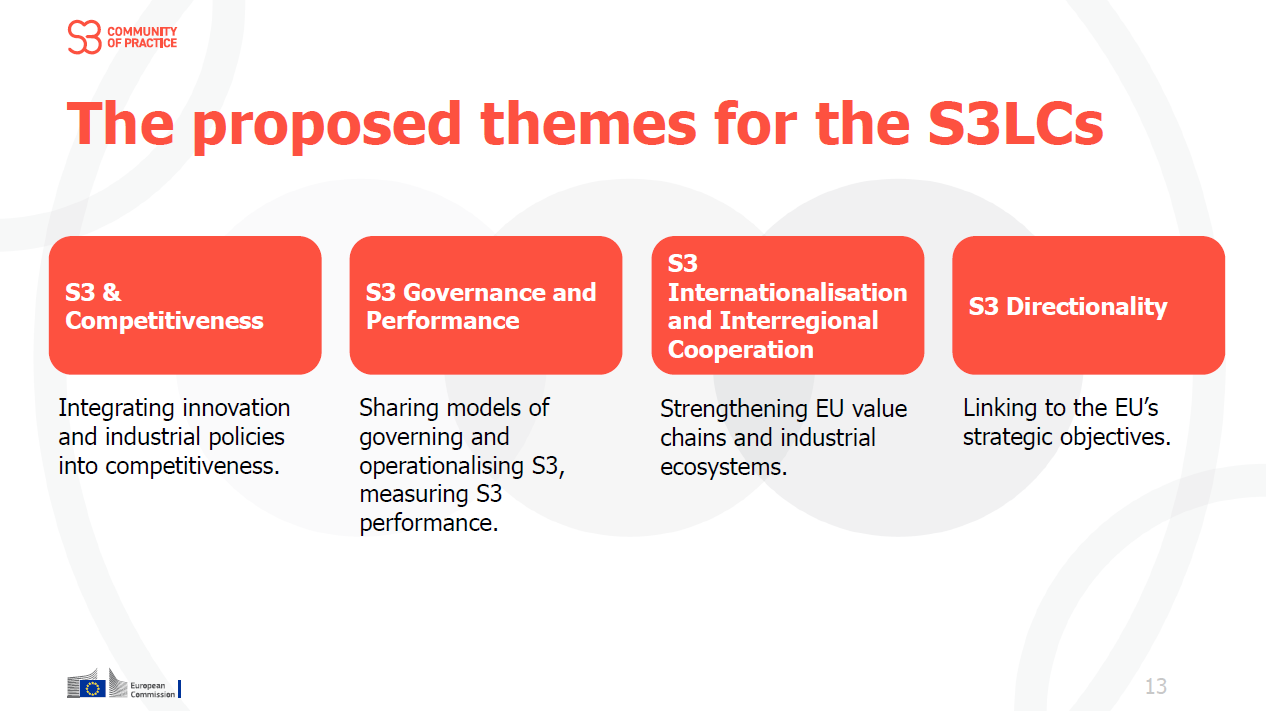
The four Learning Communities will address some of the most pressing areas for S3 practitioners:
This community focuses on how Smart Specialisation can enhance regional and European competitiveness. Discussions will revolve around innovation policies, industrial transformation, technology adoption and methods for assessing S3 impact on economic performance. Its goal is to equip regions with stronger tools to foster knowledge-based growth and strengthen resilient industrial ecosystems.
Strong governance and robust monitoring frameworks are essential for effective S3 implementation—an aspect that is gaining even more relevance with the next MFF’s performance orientation. This community will explore governance models, multilevel coordination, stakeholder engagement and advanced KPI systems. It aims to support regions in improving accountability and evidence-based decision-making.
This community will help regions connect beyond borders, integrate into European and global value chains, and establish strategic cooperation frameworks. It will also support internationalisation of innovation ecosystems and facilitate joint initiatives among territories. Strengthening interregional links is a core objective, reflecting the longstanding ambition of S3 to drive cross-border innovation.
Focusing on mission-oriented approaches, transitions, and long-term strategic thinking, this community will support authorities in defining and refining the direction of their S3 priorities. Topics include steering transformations linked to green, digital and social transitions, as well as developing effective prioritisation processes.
The ambition behind the S3 Learning Communities is clear: to create tangible outputs that benefit not only regional and national administrations but also the European Commission. As noted during the launch event’s Q&A session, the insights generated are expected to help shape thinking for the post-2027 landscape and foster a broader shift in how regions approach innovation and economic transformation.